Moab in Late Winter — Weeks Among the Stone
Late February into March. Not the postcard heat of summer. Just cold mornings, thin light, and enough quiet that the desert still feels like it belongs to itself.
Having pent several weeks based in Moab — long enough to stop “hitting the highlights” and start noticing how the place changes with an hour of weather, a shift in wind, or a road I’d already driven three times. Rolling into town after a hard drive through white-out conditions I was totally exhausted. Woke up the next morning to more snow. Perfect conditions to explore the river and Arches.
Obviously Moab is a tourist destination (in most respects a "trap") for many reasons, and seasons. Between bike riding, hiking, canyoneering, proximity to Arches and countless, road stops, trail heads and the river you can totally avoid the real character of Moab. Each day I had opportunity to meet, talk (yes, asking where to,,,) with shop owners, locals, folks at the visitor center, rangers, servers at restaurants, etc. What notably struck me is most tourist destinations are for sake of better words, horrible- food is bad, it's a checklist, prices are insane, photo ops are iconic- worse than Disneyland ("Disneyifcation"); Moab is the complete opposite. Not perfect but my 360 view reveals it's more than a bucket list to visit. More on this after next journey.
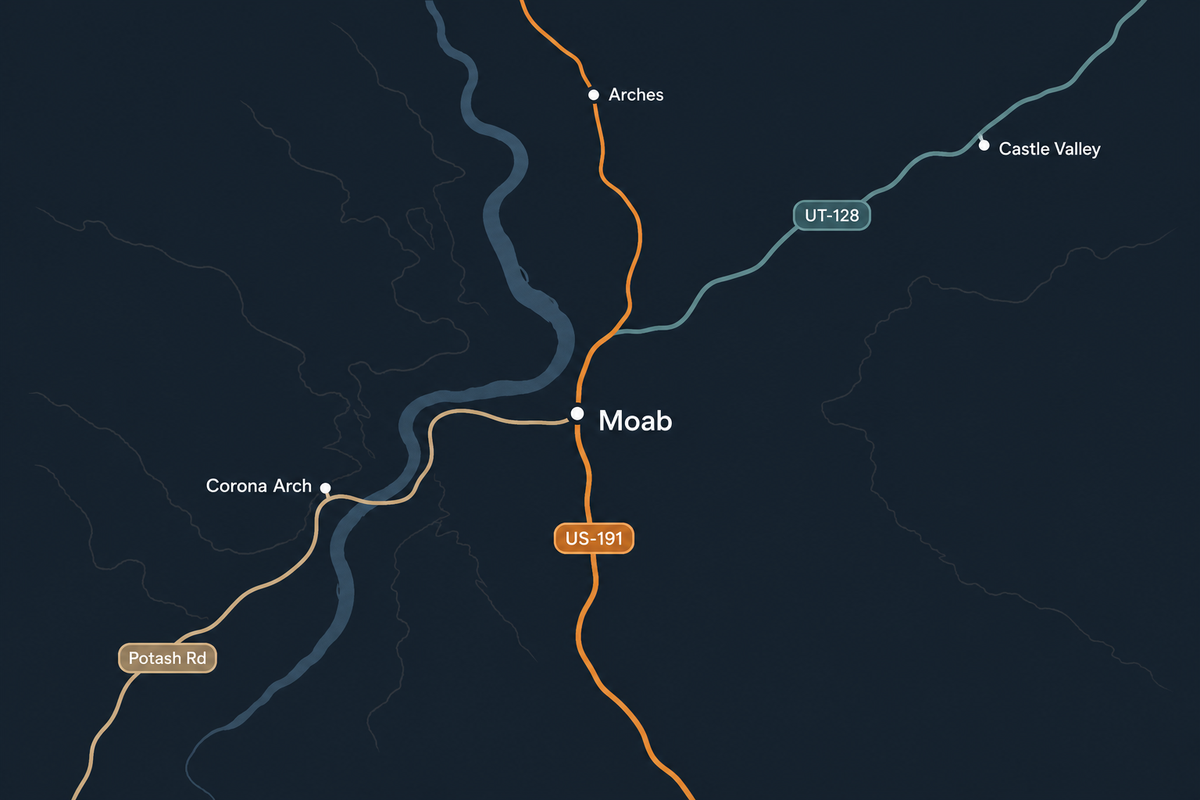
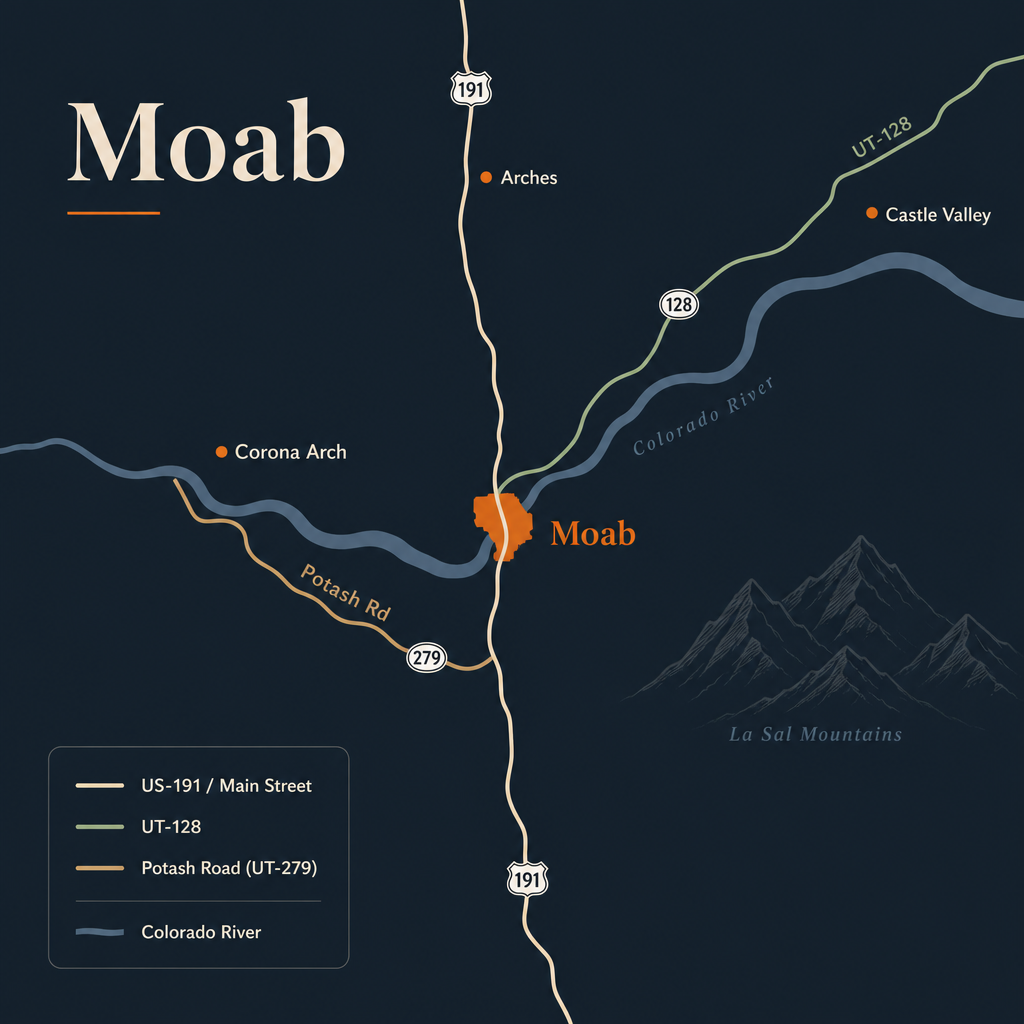
A simple map of the skeleton
Three corridors carry almost everything. Learn them once and the rest of the trip makes sense.
US-191 is the north–south spine through downtown — the stretch you can’t avoid. They say during peak it can take 20-30 mins. to pass through. It also was where my night-time near disaster occurred.
UT-128 leaves town and follows the Colorado upriver toward Castle Valley. Spectacular views either side.
Potash Road (UT-279) runs the other way along the river — quieter shelves of stone, different light. Verticle canyon walls. Famous route.
Arches sits north of town off that 191 corridor. Corona Arch lives out toward the Potash side. Castle Valley opens along 128. Same base, three moods.
Why weeks, not days
A weekend in Moab is spectacular. Weeks are something else.
You stop racing sunrise at the same overlook. You wait out a gray morning and get rewarded at 2 p.m. You learn which pulls are worth repeating and which are beautiful once. You start editing in your head before you raise the camera — landscape, aerial, a short motion cut later — because the place keeps offering new frames of the same stone.
Late winter / early spring helped. Crowds thinner. Light lower and longer. Snow still holding on the La Sals while the canyon floors stayed walkable. That contrast alone is worth the season.
The variety under one sky
Moab isn’t one landscape. It’s a cluster of moods within a short drive of each other.
Arches — sculpture and silhouette
Fins, windows, and sky-holes that beg for careful framing. At this time of year the rock holds cool color in the shade and warm edges when the sun finally clears. Go early or late; midday still works if you’re after graphic shape more than golden glow. Even after a slight dusting, trails are slippery. So prepare accordingly.
UT-128 & Castle Valley — river walls and open green
The Colorado corridor on 128 is a different story than the park entrances: water sound, cottonwoods when they’re waking, walls that close in then open toward Castle Valley. Weeks here meant returning to the same bends under different cloud decks. If you do the La Sal route counterclockwise you'll go through Castle Valley and connect to 128.
Potash Road & Corona Arch — the other river
Potash doesn’t try to compete with Arches’ fame. It doesn’t need to. Long ledges, river below, and Corona Arch as a destination that still feels earned. Good light can arrive mid-morning when the famous lots are already busy elsewhere. Entire stretch is one of the most highlighted routes in the US. Go to YouTube and you'll see.
La Sal Mountains — alpine on the edge of desert
From town they look like a backdrop. Up closer (or with a longer lens / a little altitude) they’re a second world: snow, timber, colder air. Late Feb–March made that split vivid — desert floor and winter peaks in the same frame if you choose your vantage. Fortunately when I was there road was empty. Recall maybe 20 or so vehicles. Temperature varied.
Open desert and backroads — texture and patience
Between the named places: washes, mesa tops, dirt spurs, unmarked pullouts. This is where weeks pay off. Same road, different cloud deck. Same mesa, different haze. Not every stop becomes a hero image. Enough of them become yours.
Light in this season
Short days force intention. Mornings can be sharp and blue. Afternoons stretch. Storm light — common enough this time of year — is a gift: dark bases, bright rims, curtains of weather moving across Canyonlands like a second subject.
I shot stills and motion. Some days the camera stayed down and the walk was the point. That matters more than it sounds when you’re there long enough to get greedy for “keepers.”
Downtown, lightly
Moab works as a base because the essentials sit on that 191 spine — you pass them whether you mean to or not.
A few anchors that shaped ordinary days (not a food tour — add your own favorites later):
- Visitor Center — orientation, conditions, the useful “what’s open / what’s wise today” reset
- Lazy Lizard — easy, social, the kind of place that fits a long stay more than a one-night checklist
- Library — warm, quiet, a pause when wind or weather sends you back to town
- Rec Center — excellent, clean, awesome pool and showers that put hotels to shame.
What I’d tell another photographer
- Stay longer than the highlight reel. Arches is real; so is the third morning on a quieter rim.
- Chase variety, not just icons. River, mesa, arch country, mountain backdrop — use the range on that map.
- Respect the season. Ice, mud, wind, closed spurs — check conditions; don’t force a composition that isn’t safe.
- Leave room for nothing. Some of the best hours were not “productive.” They were orientation.